
Suboccipital Muscles and Eye Strain, Headaches, and Low Back Pain Why Acupuncture Is Effective: An Anatomical Explanation
- はりきゅう堂 静
- Jun 3
- 6 min read

June 3, 2026 | Supervision: Kiyo Hari Kyudo | Reading time: 7 minutes
"My eyes feel heavy and strained." "I have a dull ache at the back of my head." "I can't go a day without headache medication."
Are you suffering from these symptoms?In today's world, where prolonged use of computers and smartphones has become the norm, the number of people suffering from eye strain and chronic headaches continues to rise. However, what many people do not realize is that the cause may not be the eyes themselves, but rather the involvement of small, deep muscles at the back of the neck.
In this article, we explain in detail the close relationship between the suboccipital muscles (a group of deep neck muscles )and eye strain, headaches, and low back pain, as well as why acupuncture treatment is effective from an anatomical perspective.
1. What Are the Suboccipital Muscles?
The suboccipital muscles are a group of four small muscles located at the deepest layer of the back of the head (at the junction of the skull and neck). They lie beneath the trapezius and semispinalis capitis muscles, making them difficult to reach with superficial finger massage.
Figure 1: Anatomical position of the suboccipital muscles. (From Human Anatomy Atlas)

Muscle | Origin | Insertion | Primary Action | Referred Pain (TrP Pattern) |
Rectus Capitis Posterior Major | C2 spinous process | Inferior nuchal line of occipital bone | Head extension, ipsilateral rotation | Occiput to vertex, temporal region, behind the eye |
Rectus Capitis Posterior Minor | C1 posterior tubercle | Inferior nuchal line of occipital bone | Head extension, fine adjustment | Suboccipital region, temporal region, behind the eye, forehead |
Obliquus Capitis Superior | C1 transverse process | Inferior nuchal line of occipital bone | Head extension, lateral flexion | Temporal region, behind the eye, forehead |
Obliquus Capitis Inferior | C2 spinous process | C1 transverse process | Head rotation | Occiput, temporal region, behind the eye |
The suboccipital muscles are located approximately 2ー3 cm beneath the skin surface and are difficult to release with regular massage. The major advantage of acupuncture treatment is that fine needles can directly reach these deep muscles.
An Unexpected Relationship Seen Through Fascial Connection ーSuboccipital Muscles and Low Back Pain
Suboccipital muscle tension is known to contribute not only to headaches and eye strain but also to low back pain. In the Anatomy Trains concept, the Superficial Back Line (SBL) connects the plantar fascia → calves → hamstrings → erector spinae → suboccipital muscles →scalp as a continuous fascial line. When the suboccipital muscles at the top of this line become tight, the tension propagates through the entire fascial system, potentially causing lumbar hypertonicity and pelvic anterior tilt, leading to chronic low back pain. Conversely, releasing the suboccipital muscles often alleviates lower back tension → the clinical observation that "the neck and lower back are connected" is supported by fascial continuity.
2. The Close Relationship Between Suboccipital Muscles and Eye Strain
The Suboccipital Muscles as "Secondary Extraocular Muscles"
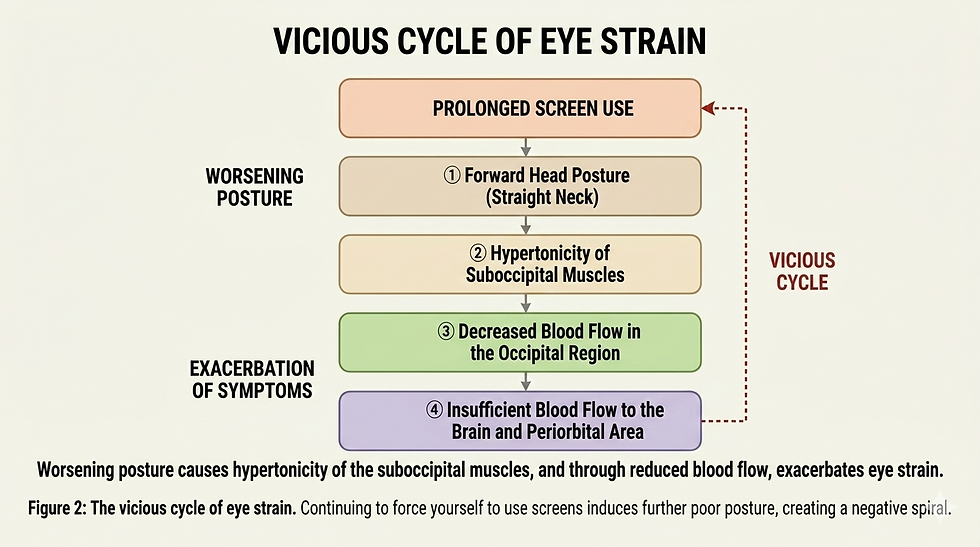
The suboccipital muscles function as a stabilizing base for the head during eye movements and focus adjustment. This is similar to the image stabilization function of a camera.
Focusing on a smartphone screen ーeyes move downward and inward
In coordination, the suboccipital muscles contract to stabilize the head
During prolonged desk work, the suboccipital muscles remain continuously tense
Evidence: The Link Between Eye Movement and Suboccipital Muscle Activation
Studies have confirmed that merely moving the eyes significantly increases electromyographic (EMG) activity in the suboccipital muscles. In other words, "using the eyes = tiring the suboccipital muscles." This connection is explained by a neural network called the trigemino-cervical complex.
3. Suboccipital Muscles and Headaches 窶� The Trigemino-Cervical Complex
The Trigemino-Cervical Complex
This is a neural network where the trigeminal nerve (cranial nerve V), which governs facial sensation, and the upper cervical nerves (C1ー3), which govern neck sensation, converge and integrate at the level of the brainstem.
Figure 3: Trigemino-cervical complex.


4. Why Acupuncture Treatment Is Effective
4-1. Direct Approach to Deep Muscles
The suboccipital muscles are located 2ー3 cm beneath the skin surface. In acupuncture treatment, ultra-fine needles (0.16ー0.20 mm diameter) are inserted to the target muscle, producing synergistic effects through local muscle tension release, central nervous system pain inhibition, and autonomic regulation.
Figure 4: Three mechanisms of acupuncture action.

4-2. Activation of the Descending Pain Inhibitory System
Acupuncture stimulation activates the brain's descending pain inhibitory system. This pathway passes through the periaqueductal gray (PAG) ーrostral ventromedial medulla (RVM) and the locus coeruleus in the pons, inhibiting pain transmission at the spinal dorsal horn. As a result, serotonin and noradrenaline are released in the spinal dorsal horn, while humoral mechanisms involving ホイ-endorphin also act in parallel, producing an analgesic effect.
4-3. Autonomic Nervous System Regulation
Suboccipital muscle tension may affect autonomic function through mechanical stimulation of the adjacent dura mater and nociceptive input to the upper cervical spinal cord. Acupuncture-induced parasympathetic activation improves heart rate variability (HRV) and induces a systemic relaxation response, which can also help alleviate autonomic disturbances associated with eye strain (insomnia, dizziness, palpitations, etc.).
4-4. Integrated Approach to the Trigemino-Cervical Complex
Acupuncture treatment approaches the suboccipital muscles through fascial connections (the detailed mechanisms are still under investigation), modulating abnormal input to the trigeminal spinal nucleus. This suppresses sensory hypersensitivity in the ophthalmic nerve (V1) territory, improving pain behind the eyes and eye strain. Compared to medication, acupuncture has fewer systemic side effects, although appropriate technique and safety management are required.
※ The causal relationship that acupuncture stimulation induces these neurophysiological mechanisms has been relatively clearly demonstrated in animal studies; however, mechanistic evidence in humans is still developing, and further research is awaited.
5. Treatment Approach at Kiyo Hari Kyudo
Suboccipital Muscle Approach
Visual inspection & palpation: Assess suboccipital muscle tension, location of referred pain, and tender points
Identify and precisely needle the causative suboccipital muscle: Direct approach to the suboccipital muscles
Deep stimulation: Insert needles through the semispinalis capitis to reach the suboccipital muscles
Electrical acupuncture if needed: Low-frequency electrical stimulation for stronger muscle relaxation
Other Approaches for Eye Strain
Acupoint | Location | Expected Effect |
Zanzhu (BL2) | Depression at medial eyebrow | Improves blood flow around eyes |
Yuyao (EX-HN4) | Midpoint of eyebrow | Relaxes orbicularis oculi tension |
Taiyang (EX-HN5) | Midpoint between lateral eyebrow and lateral canthus | Effective for headaches and eye strain |
Jingming (BL1) | Nasal side of inner canthus | Promotes deep blood circulation |
Fengchi (GB20) | Below occipital bone, between sternocleidomastoid and trapezius | Direct approach to suboccipital muscles |
Tianzhu (BL10) | Below occipital bone, lateral border of trapezius | Essential for headaches and shoulder tension |
6. Self-Care Tips
1. Adjust Screen Height: Position your monitor so that its top edge is at or slightly below eye level. For laptops, use a stand and an external keyboard.
2. Take Frequent Breaks: Take regular breaks ー aim for 25 minutes of work followed by 5 minutes of rest. During breaks, make it a habit to look into the distance and gently rotate your neck.
3. Maintain Good Posture: Keep your ears, shoulders, and hip joints aligned in a straight line. Maintain a neutral pelvis and open chest.
4. Keep Your Neck Warm: Cold exposure stiffens muscles, especially in the occipital region. Avoid direct air conditioning drafts in summer, and use a scarf or towel when needed.
7. Summary
Suboccipital muscle tension in the deep neck has been attracting attention as a contributing factor to eye strain and chronic headaches.
The suboccipital muscles act as "secondary extraocular muscles" (a metaphorical expression) supporting eye movement and focus adjustment
Their over-tension causes headaches and pain behind the eyes via the trigemino-cervical complex
Acupuncture treatment is effective through direct deep muscle approach combined with nervous system regulation
Multiple studies have reported that approaches targeting the suboccipital muscles may be effective in improving symptoms of headaches and eye strain
Rather than temporarily suppressing symptoms with eye drops or headache medication, consider trying acupuncture treatment that addresses the root cause.
References
Fernández-de-las-Peñas C, et al. Trigger points in the suboccipital muscles and forward head posture in tension-type headache. Headache. 2006;46(3):454-460.
Sedighi A, et al. Comparison of acute effects of superficial and deep dry needling into trigger points of suboccipital and upper trapezius muscles in patients with cervicogenic headache. J Bodyw Mov Ther. 2017;21(4):810-814.
Cho IH, et al. The effects of acupuncture on occipital neuralgia: a systematic review and meta-analysis. BMC Complement Med Ther. 2020;20(1):171.
Li Y, et al. Acupuncture plus massage for cervicogenic headache: a systematic review and meta-analysis. Medicine. 2021;100(51):e28351.
Šedý J, et al. Cervicogenic orofacial pain and trigeminocervical convergence. Medicina. 2022;58(10):1324.
Bexkens R, et al. Refractory neuropathic pain in the head and neck: neuroanatomical and clinical significance of the cervicotrigeminal complex. Life. 2025;15(9):1457.
日本鍼灸大学. 鍼灸師のための解剖学入門㉔:後頭下筋群とツボ. 2025.
静はりきゅう堂 Kiyo Hari Kyudo | Offering cosmetic acupuncture, general acupuncture, and body remodeling acupuncture in Osaka City.
If you are suffering from eye strain or chronic headaches, please feel free to contact us.
©️2026 Kiyo Hari Kyudo


