
Mobile Acupuncture and Cosmetic Acupuncture in Osaka: Kiyo Harikyudo
Return to home ↑

About Cosmetic Acupuncture
What is cosmetic acupuncture?
Cosmetic acupuncture (also known as facial acupuncture or cosmetic acupuncture) is a minimally invasive treatment that involves inserting ultra-fine sterile needles into specific points on the face, head, and body to promote natural rejuvenation, lifting, and overall skin health. Unlike surgical or injection-based cosmetic procedures, cosmetic acupuncture works with the body's own healing mechanisms to produce gradual, natural-looking improvements.
The treatment is grounded in the principles of Traditional East Asian Medicine (TEAM), which views the face as a reflection of the overall health of the body. By stimulating specific acupuncture points, the treatment aims to:
• Improve local blood circulation and lymphatic drainage
• Release tension in the facial muscles (expression muscles)
• Activate the body's natural wound-healing response
• Regulate the autonomic nervous system for systemic balance
One of the most significant advantages of cosmetic acupuncture is its safety profile. Since it uses no chemicals or synthetic substances, the risk of allergic reactions or adverse effects is extremely low. There is virtually no downtime, and most patients can resume their daily activities immediately after treatment.
Furthermore, cosmetic acupuncture addresses both external appearance and internal health simultaneously. While the direct stimulation of facial tissues promotes collagen production and improves skin tone, the systemic effects of acupuncture help regulate hormone balance, reduce stress, and improve sleep quality — all of which contribute to a healthier, more radiant complexion.

Skin structure and turnover
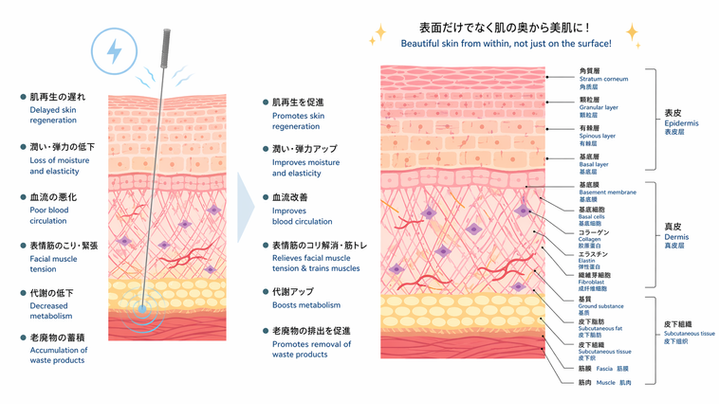
The skin has a three-layered structure: from top to bottom, it consists of the epidermis, dermis, and subcutaneous tissue. The epidermis is about the thickness of plastic wrap (0.1-0.3 mm), depending on the location, and is made up of four layers. From the inside out, these layers are stacked in the following order: basal layer, spinous layer, granular layer, and stratum corneum.
Individual cells in the basal layer at the bottom divide in cycles of about two weeks (one of the two cells remains in the basal layer) to produce keratinocytes. These keratinocytes are pushed upward by newly formed cells, gradually changing into a flattened shape as they move toward the surface, eventually becoming corneocytes, and finally sloughing off as dead skin cells over approximately 28 days. This process of the epidermis constantly being replaced with new cells is called cell turnover. When this turnover slows down due to aging or cold, it can cause dullness of the skin.
The dermis is 10 times thicker than the epidermis, ranging from 1 mm to 3 mm in thickness. It is composed of 60% to 80% water, and is made up of collagen, elastin, and hyaluronic acid. These are produced by fibroblasts. Other structures found here include sweat glands, sebaceous glands, fur, and blood vessels. The dermis is the source of skin elasticity and firmness. When the function of the fibroblasts in the dermis declines due to aging or the effects of ultraviolet rays, the dermis, which normally undergoes a turnover cycle of several months to several years, deteriorates, leading to wrinkles and sagging.


Facial Muscles
Facial muscles, also known as cutaneous muscles, are directly connected to the bone at one end and the skin at the other. Skeletal muscles are located between bones and are connected to bone at both ends, making them structured to easily maintain their correct position. However, facial muscles are not. Therefore, when the muscles weaken, it becomes difficult for the skin to maintain its correct position, leading to wrinkles and sagging. In particular, with age, muscle activity decreases, and the muscles become stiff and lose flexibility. As a result, wrinkles appear in those areas, and aging is accelerated due to poor blood flow and lymphatic congestion. By applying acupuncture to the facial muscles, the muscles can be stimulated, producing cosmetic effects. Furthermore, facial muscles are influenced by serotonin. Serotonin is also known as the "happiness hormone," and an increase in serotonin leads to more expressive facial expressions.


Wound healing effect
When the human body is injured, it attempts to repair the damaged area through its natural healing abilities. Many cosmetic medical treatments utilize this mechanism, and laser treatments and derma rollers also use this mechanism to promote skin regeneration. Cosmetic acupuncture induces the accumulation of various growth factors that promote the repair of the damaged area by causing microscopic damage to the skin, thereby promoting tissue reconstruction.
During the wound healing process induced by acupuncture, various cytokines involved in cell proliferation and the activation of fibroblasts are promoted, leading to increased production of extracellular matrix components such as collagen fibers and elastic fibers. This improves skin sagging and firmness.

The effects of cosmetic acupuncture

◎A reflex called the axon reflex occurs in the area where the needle is inserted, and a substance called CGRP is released, which affects the skin and
Blood flow to the facial muscles is significantly improved, and metabolism is promoted.
◎By relieving tension in facial muscles and improving circulation, wrinkles will be reduced.
◎Improved blood flow leads to better lymphatic drainage, which helps remove waste products and improves sagging skin.
◎The wound healing effect on minute wounds reactivates collagen, elastin, etc.
◎Skin metabolism is promoted, cell turnover is regulated, and skin regeneration is promoted.
◎Stimulating the face releases serotonin, which has a positive effect on mental health.
◎Eyes look refreshed and brighter.
◎Improves rough skin
◎ Lifting the corners of the mouth (facelift)
◎Improvement of skin tone
◎Improvement of skin texture
◎ A more defined jawline (reduction of puffiness)
◎Reduces teeth grinding (for a smaller-looking face)
◎The autonomic nervous system becomes more balanced, leading to increased feelings of happiness and vitality.
Scientific evidence of cosmetic acupuncture
■Scientific Evidence for Cosmetic Acupuncture
For centuries, the effects of cosmetic acupuncture were described primarily through the lens of traditional wisdom and clinical observation. In recent years, however, a growing body of scientific research has begun to validate these effects using modern measurement techniques. Below are some of the key studies that support the efficacy of cosmetic acupuncture.
▼MRI Study Demonstrates Effect on Masseter Muscle Volume (2024)
A landmark study published in 2024 used magnetic resonance imaging (MRI) to objectively measure the effect of facial acupuncture on the masseter muscle — the primary muscle involved in chewing and jaw clenching. The study found that after a series of facial acupuncture treatments, the volume of the masseter muscle decreased by an average of 7.37%, and the cross-sectional area of the muscle also showed a statistically significant reduction.
These findings indicate that acupuncture stimulation effectively relaxes hypertonic (over-tense) masseter muscles, allowing them to return to a healthier, more balanced state. This provides the first objective, image-based evidence supporting the "face-slimming" and "jawline-defining" effects long reported by cosmetic acupuncture practitioners.
Reference: University of Oxford, et al. "The effect of acupuncture on masseter muscle volume: An MRI study" (2024)
▼CNT (Carbon Nanotube) Needle Study (Hiroshima University × Kao Corporation, 2026)
A collaborative research team from Hiroshima University and Kao Corporation investigated the effects of ultra-fine stimulation on skin quality using carbon nanotube (CNT) needles — approximately 1/1000th the diameter of conventional metal acupuncture needles. The study demonstrated that even such extremely fine stimulation produced measurable improvements in:
• Skin moisture content (significant increase)
• Transepidermal water loss (TEWL) reduction, indicating improved barrier function
• Cutaneous blood flow (marked enhancement)
The finding that even CNT-scale stimulation can elicit clear physiological changes in skin barrier function and blood flow dynamics strongly suggests that conventional cosmetic acupuncture needles (typically 0.12 mm – 0.20 mm in diameter) are more than capable of producing meaningful therapeutic effects on the skin.
Reference: Hiroshima University, Kao Corporation. "Effects of CNT needle stimulation on skin barrier function and blood flow" (2026)
▼Additional Evidence
Beyond these two studies, the evidence base for cosmetic acupuncture continues to grow. Basic research has demonstrated that facial acupuncture stimulation can activate fibroblasts — the cells responsible for collagen and elastin production. Clinical studies, including randomized controlled trials (RCTs), have examined the efficacy of cosmetic acupuncture for periocular wrinkles, skin laxity, and overall facial rejuvenation, with promising results.
Furthermore, multiple studies have reported that acupuncture's systemic effects — including serotonin release, stress reduction, and improved sleep quality — indirectly contribute to healthier skin by supporting normal cell turnover and hormonal balance.
Cosmetic acupuncture is evolving from a practice rooted in tradition and clinical experience to one supported by modern science and objective evidence. At our clinic, we integrate these evidence-based insights with personalized treatment plans to help each patient achieve their optimal results.
About Bruising (Subcutaneous Bleeding)
The needles used are very thin, so bleeding is almost nonexistent. However, even with the utmost care during treatment, bleeding or bruising may occur depending on the client's physical condition and constitution. The face, in particular, has a high density of capillaries, and even a skilled acupuncturist finds it difficult to completely avoid these tiny vessels. If you have a significant bleeding tendency due to medication or illness, or if you have an upcoming event such as a wedding or photoshoot, please be sure to consult with us before treatment. Please do not worry if bruising occurs. Bruising from acupuncture is similar to a "blue bruise" and will be absorbed and disappear after a while.
At home, initially apply cold and pressure to the area. Avoid rubbing, as this can spread the bruise; simply apply light pressure. After about 3 hours, it is recommended to apply warmth to speed up reabsorption. Initially, the bruise will be purple, gradually changing to yellow over a few days before disappearing. For most people, it disappears within 3 days to 2 weeks (this varies depending on physical condition, constitution, and lifestyle). Initially purple, it changes to yellow over a few days and then disappears. In traditional East Asian medicine, internal bleeding is considered a positive phenomenon, a kind of detoxification. It is believed that bad blood is expelled from the body, activating metabolism in that area and transforming damaged skin into new skin. In fact, many patients report that their skin becomes plumper after internal bleeding has healed.
