
Mobile Acupuncture and Cosmetic Acupuncture in Osaka: Kiyo Harikyudo
Return to home ↑

About acupuncture
Indications for acupuncture treatment according to the World Health Organization (WHO) (1986: 41 types of indications)
When you hear the word acupuncture, you probably think of treating stiff shoulders, lower back pain, or general muscle stiffness, but the WHO has established that acupuncture is effective for the following conditions: 1. Upper respiratory tract and respiratory diseases
Acute maxillary sinusitis Bronchial asthma Acute rhinitis Acute tonsillitis Acute bronchitis Common cold
2. Eye diseases
Central retinitis Acute conjunctivitis Cataract Myopia
3. Oral diseases
Acute pharyngitis, post-extraction pain, gingivitis, toothache
4. Gastrointestinal diseases
Acute chronic gastritis, acute chronic enteritis, hyperacidity, esophageal sphincter spasm, hiccups, paralytic ileus, chronic duodenal ulcer, acute duodenal ulcer, acute bacterial diarrhea, gastroptosis and constipation, diarrhea
5. Neurological and musculoskeletal disorders: Facial nerve paralysis, sciatica, intercostal neuralgia, trigeminal neuralgia, neurogenic bladder dysfunction, nocturnal enuresis, peripheral nerve disorders
Meniere's disease, arthritis, paralysis due to bruising, lower back pain and headache, migraine, complications of polymyositis, cervicobrachial syndrome (frozen shoulder, tennis elbow)
What is acupuncture treatment?
Acupuncture is a historical form of Oriental medicine that originated in China over 2,000 years ago and was introduced to Japan about 450 years ago during the Azuchi-Momoyama period. Today, it is practiced as a traditional medicine in many countries, and its techniques and theories have developed independently in Japan and China. Currently, Chinese-style acupuncture is the mainstream worldwide, but the merits of Japanese acupuncture, which has been developed to suit the delicate sensibilities of Japanese people, are gradually gaining recognition and popularity.
Acupuncture is a treatment that involves stimulating approximately 400 acupoints (tsubo) in the human body using needles as thin as a strand of hair. This stimulation triggers various reflexes, strengthening the body's self-healing and immune systems, thereby fundamentally improving various ailments.
While acupuncture may be strongly associated with treating stiff shoulders, lower back pain, and injuries, it is actually effective for a wide range of symptoms, including beauty concerns, hair growth, gastrointestinal disorders, autonomic nervous system disorders, mental illnesses, and endocrine disorders. The U.S. National Institutes of Health (NIH) published an opinion on the effectiveness of acupuncture in 1997, acknowledging its efficacy and scientific basis. Acupuncture's applications are expanding to include menopausal symptoms and pain relief, mental health care, and infertility treatment, and it is supported by many people as a treatment with no side effects.
What are acupressure points?
In Oriental medicine, it is believed that energy, known as "qi" and "blood," circulates throughout the body via pathways called "meridians," sustaining vital functions. Points along these meridians, like stations, are called acupoints (tsubo). When the flow of energy through the meridians becomes stagnant, various ailments appear in the body. Sometimes pain, sometimes temperature changes, and sometimes sweating may appear along the meridians, and these are signs of dysfunction in the organs located along that meridian. Acupuncturists assess the state of the acupoints along the problematic meridian to understand the internal ailments, and then stimulate those points using needles or moxibustion to regulate the circulation of qi and blood, leading to improvement of the ailments.
The human body has a total of 394 acupuncture points: 361 points known as the regular meridians and extraordinary meridians, and other points known as the extraordinary points. Including the number of points that appear as reaction points (Ashi points), the total number is even greater. So, what exactly are acupuncture points? In recent years, it has become clear that acupuncture points are primarily located in important areas such as vital nerves and fascia (muscles, blood vessels, and tissues). Western medicine also recognizes that ailments appearing at acupuncture points are related to dermatomes on the body surface, where internal organ dysfunction manifests as sensory disturbances in areas of the skin innervated by the same nerves. Evidence for acupuncture points is accumulating year by year, deepening our scientific understanding.
The World Health Organization (WHO) published a list of 43 diseases for which acupuncture is indicated in 1979, and achieved international standardization of acupoint names and locations in 2008. Currently, research and clinical practice of Oriental medicine are actively developing in many countries under the category of traditional medicine, and Oriental medicine as a whole is attracting considerable attention. Although Japan lags behind other countries, the number of hospitals and medical institutions incorporating Oriental medicine is increasing year by year, and it is achieving results, particularly in improving the quality of life for terminally ill cancer patients.
About the needles used
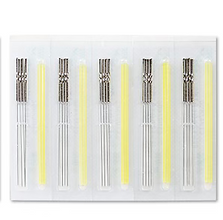
We use sterilized, disposable needles. We select the needle depending on the treatment area and the patient's condition, but the needles we use are as thin as a strand of hair, with a diameter of 0.14 to 0.34 mm. Comparing a 20G (0.9 mm diameter) injection needle used in hospitals with a No. 3 acupuncture needle (0.20 mm), the injection needle is 4.5 times larger in diameter, and its cross-sectional area is 20 times larger (4.5 x 4.5 = 20.25). Also, the tip of an injection needle is designed to cut sharply, but acupuncture needles are rounded, so there is almost no pain or bleeding. In addition, silicone-coated needles are becoming mainstream, further reducing pain during insertion to the greatest extent possible.

About disinfectant

At our acupuncture clinic, we use alcohol to disinfect our hands, but we use benzalkonium chloride solution, an ingredient in quaternary ammonium compounds, for disinfecting the acupuncture site. Therefore, please rest assured that this disinfection method is gentle on those who are sensitive to alcohol, and is also suitable for the face and scalp.
鍼治療の科学——もっと詳しく知りたい方へ
次のページでは、鍼治療がどのようなメカニズムで効果を発揮するのか、科学的な視点から詳しく解説します。